Showing posts with label family learning. Show all posts

Friday, January 17, 2020

Week in Review - 1/13/20 to 1/17/20

I haven't done a week-in-review post in so long! I hope I can remember how to do them, ha!

We "traveled" to North America in geography this week, beginning with Mexico. We learned some interesting facts about Mexico, did some mapping activities, colored the flag, and practiced some Spanish words. We also learned the colors in Spanish. The kids make a postcard for each country every week. We also made Atzec suns with air-dry clay, paper bag maracas, and drew sombreros using a YouTube tutorial. We ate tacos on Sunday after church. I planned to go out and eat Mexican food, but it didn't happen this week.


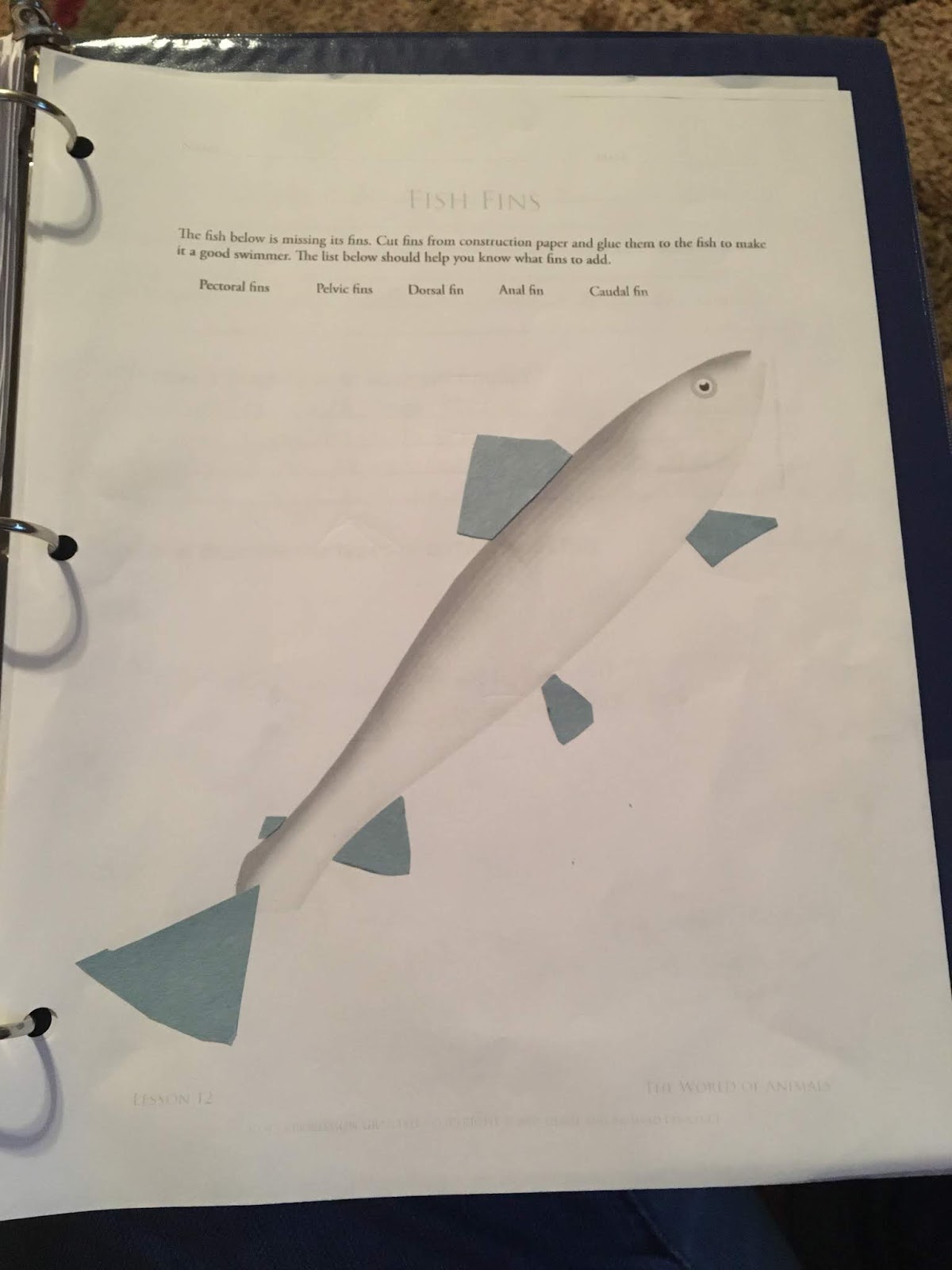
In science, we learned all about fish! The kids learned how fish breathe, the difference in bony fish and cartilaginous fish, and the different types of fins. They cut fins out of construction paper and glued them to a fish and drew and described the different fins.


We completed week two in Bible Road Trip, Year One, including three notebook pages. We memorized John 1:17 and reviewed 2 Timothy 3:16-17 from last week. We read Acts 25-26 and Luke 23-24.

 
Titus learned about fractions this week and played with our "Fraction Action" game. Mercie learned how to multiply and divide decimal numbers, and Silas reviewed multiplication and division facts.

We had our homeschool group's 4H meeting on Monday, and Mercie and Silas each gave a short presentation. Each officer takes one meeting to provide a guest speaker or do their own presentation. Mercie and Silas are both officers, so we had two meetings to supply! My mom came in November and spoke about her and my dad's mission trips to Nicaragua. (They are full-time missionaries.) This month, Mercie gave a presentation on the horseman of the Apocalypse and Silas gave one on the temptations of Jesus. They did a great job!

Wednesday we had TeamKID at our church. I'm the director and I also teach the Bible lesson each week. This week we talked about the importance of the Bible, and our memory verse was 2 Timothy 3:16-17 (which was our memory verse last week in Bible Road Trip).

I always love doing this week-in-review posts because it's so nice to see how much we actually do each week! We are finished with schoolwork by lunch almost every day, so it's easy to think we aren't doing "enough". These posts always remind me that we are doing plenty!

How was your week?


Monday, May 2, 2016

Different Science Curriculum for Four Kids? Yes, We Are.

I have promoted Family Learning on my blog quite a bit, and I still encourage and utilize Family Learning in our homeschool. But this year, we decided to go a different direction for my children's science curriculums {curricula?}.

Why? I was having a hard time teaching science to a 7th and 5th grader without going over my 2nd grader and Kindergartners heads. When I tried to teach it more simply, my two older kids were bored senseless. I tried adding some extra books for each child, on their level, but I found I was working just as hard to teach them all the same thing as I would be if I were teaching them all different things.

I am all for simple homeschooling but I don't want my older children to be slighted nor do I want my younger children to miss out on hands-on activities and fun learning.

So this year, I ordered all four of my children different science curriculum. Mikaela and Eli, who will be in 8th and 6th grade, will have a textbook-type science curriculum. I ordered them each a set from Master Books in the Wonders of Creation series. There are two textbooks and a Parent Lesson Planner in each set. They will work independently, three days a week, on their science. It counts as 1/2 credit, which is great for my 8th grader. Mikaela will be studying Oceanography and Ecology, and Eli will be studying the Weather and Astronomy. This series is for children in 7th - 9th grade, so the next year, they will swap books and I will order a new PLP for each of them {around $10}. Very cost effective!
Intro to Meteorology & Astronomy Pack, 3 Volumes The Wonders of Creation SeriesIntro to Oceanography & Ecology Pack, 3 Volumes The Wonders of Creation Series  -
Mercie will be in the 3rd grade, and she will be using Science Starters: Elementary Physical and Earth Science from Master Books. This is a 3-day a week program with fun experiments and demonstrations. It's geared for grades 3-6, so I am going to make it more simple for her by not making her do all of the worksheets and quizzes.
Science Starters: Elementary Physical & Earth Science (Curriculum Pack)
Silas has never had science, but he will be only be in 1st grade. I am going to use Winter Promise's The World Around Me with Silas. He will be learning basic science topics such as energy, force and water. This is a literature based program, which I love! Here are some of the books he will be using.

Childrens_EncyclopediaThe_Night_SkyMore_Fun_with_NatureWater_Water_EverywhereStory_of_InventionsScience_Play


Do you homeschool science together? Separately? What curriculum are you using? Let me know in the comments! 

Saturday, April 23, 2016

Week in Review: April 18-22, 2016

This week flew by, like all other weeks. The weather is getting beautiful, and we are spending more and more time outside. We will be going home to Louisiana in a few weeks, and the kids are getting homesick! I am looking forward to spending time with my parents, who will be home from Nicaragua for a few months.

Family Learning:

In BiblioPlan this week, we talked about the Law and the wilderness - when Moses and the Israelites wandered in the desert. We talked about the Tabernacle, the items inside of it, and the way it was set up. The kids drew a diagram of the Tabernacle for their notebooks, and Eli made a Tabernacle out of Legos.

We also completed a map and added to our timelines.

In science, we learned about food chains and food webs. We defined our vocabulary words, read an extra book called, "What Are Food Chains and Webs?" This book was very interesting and will be an asset to our ever-growing living book library.

I had the kids draw their own version of a food web:
 
We read more in our Billy Graham biography and about our composer, George Handel.
 
Individual Learning:

Mikaela, Eli, and Mercie are all using Learning Language Arts Through Literature. What a great program! It includes copywork and dictation, light grammar instruction, literature selections, spelling, and so much more. We are really happy with this curriculum.

Mikaela is using Writers in Residence and loving it. I'm planning to start Eli on it soon.

In math, Mercie is learning how to read a clock, Eli completed Chapter 1 in Rod and Staff math, and Mikaela is on Chapter 8 in Principals of Mathematics, learning about ratios and proportions.

Mikaela is reading "King Arthur" and is almost through with the literature guide from Memoria Press. Eli is reading "Carry On, Mr. Bowditch" for LLATL.

Silas and Titus had fun this week learning about the letter X and God's treasure - the Bible. I wrote about it in THIS post.
 

Silas is moving right along in Math-U-See Primer, and he is on lesson 16. He loves MUS! He is learning to add small numbers, reading 3 digit numbers, and writing from 1-20. He has trouble with the numbers 12-19, for some reason! We are in between lessons 22 and 23 in Foundations A {Logic of English}. We have been playing games and reviewing the sounds he has learned so far. He loves to play "Go Fish" using the letter cards and sounds. {"Do you have a /t/?"} He even read a few short words, like "dog", "pig", "sit" and "top".

I am pretty happy with our progress this year! I'm already "planning" next year, but we are going to finish what we are using now! The only thing I will have to buy is Writers in Residence for Eli and a new math for Mercie, as she is almost through with Singapore 2B. Mikaela will also need her own science, and I am currently looking at a few from Master Books.

How was your week?
 

Wednesday, March 30, 2016

Charlotte Mason Homeschooling, Part 2: Multiple Ages


This is the second in a three part series of Charlotte Mason Homeschooling. These are the other posts:

Day 1: The Early Years
Day 2: Multiple Ages
Day 3: Enrichment Studies

Most homeschooling families have more than one child, and some have quite a few! I have five children, which seems like a lot at times and not enough at others! Homeschooling multiple children of multiple ages can be tricky. Having to juggle three, four, five, or even six different curriculums would be, in my opinion, impossible. I much prefer, as do many families, to have Family Learning for many of core subjects.

How can you homeschool five kids with a ten year age gap? How can a 13 year old learn alongside a 5 year old? Won't one of them suffer? How is this possible? These are questions I have been asked, and questions I have asked myself at times!

The core subjects that are most easily combinable are history, geography, science, Bible, and enrichment studies {artist, composer, and poetry studies}. Math and grammar will have to be done individually at each child's grade level. However, the core subjects I listed above are very easy to adapt to fit each child's level, while everyone is learning the same thing.

We use BiblioPlan for history and geography. It is written for grades Kindergarten through 12th grade. Of course, my older children understand and remember more, but my younger children do remember key events and people, learn mapping skills, and enjoy creating projects from the time periods we are studying. Here is a post where I explain how we use BiblioPlan for multiple ages.

We are using Christian Kids Explore for Science. It is written for grades Kindergarten through 6th grade, but is very easy to adapt to older children. Simply add more literature, more research, or more experiments.

Here are some things to keep in mind when homeschooling multiple ages with one curriculum:

  • Notebooking! This is a wonderful tool that any age can participate in. I simply give a few guidelines for my children's notebook page {a topic or theme} and they create their own pages. My 5 year old may draw a picture and write a word or two, while my 13 year old creates wonderfully illustrated and fact-filled notebook pages. You can also print notebooking pages from sites like, Notebooking.com.
  • Mapping! I make copies of the same map for all 5 of my children. My youngest two don't really know what they're doing, but they are learning to follow directions, mapping skills, and pre-writing skills.
  • Literature! Buy or borrow a few living, picture books for your younger children that correspond with the same time period or science topic. This will help them understand what you're talking about and creating interest.
  • Family projects! Instead of creating 4 or 5 paper crafts each week {that will no doubt be thrown away}, work on a family project from the time period you're studying {or the science topics}. That way, your children will learn teamwork and will work on something that will be useful and kept for many years to come.
  • Keep little hands busy! Allow your little ones to play quietly with play-dough or color a picture while you are reading longer passages. Their minds will be listening to you, but their hands will be busy and their mouths will be quiet.
  • Narrations! Allow each child to give a narration from different literature or passages read, adjusting expectations for their ages.
I hope these tips have helped you! Check back here tomorrow for some tips on Charlotte Mason Enrichment Studies.

Read some more posts from participating Crew members for more tips for homeschooling parents!


Emilee @ Pea of Sweetness

5 Days of Tips for Homeschool Parents

Saturday, February 27, 2016

Week in Review: Feb. 22 - 26, 2016

We had completed this week of homeschool in North Carolina! We are still trying to get used to a new area - find libraries, grocery stores, parks, and fun stuff. We did an entire week of school though. I always find it easier to do school when we are not "home" {Louisiana}. So many people and activities vie for our time and attention, and it really distracts us. When we are away from "home", it seems we complete much more in school and have more down time.

We finished Week 4 in BiblioPlan: Ancients this week. I cannot tell you enough how perfect this has been for our family so far. Being able to include everyone at their own skill level is just wonderful. We learned about Abraham this week. We read about him in the Bible each morning, and then we read from other sources - Story of the World; the BiblioPlan Companion; and Journey Through the Bible. We had some good discussion, and although we have read this story many times, we learned some new things. For instance, Abraham's father, Terah, worshipped idols and was probably an idol-maker {according to Jewish tradition and other historical writings}. Sarai was even named for a false god! We also learned that Ishmael is credited with being the father of Islam {which I already knew, but the kids didn't}.

The kids made a notebook page on Tuesday about Abraham. I don't give them any instructions; I only give them the topic or theme. I asked them to make a notebook page about Abraham with some interesting facts. That was it. I am including a picture of all 4 of their notebook pages to show how different they all are and how all ages can participate.

{Top Left- Silas, age 5; Top Right - Mercie, age 8;
Bottom Left - Eli, age 10; Bottom Right- Mikaela, age 13}


We had a creative writing or copy-work assignment on Wednesday. Mikaela had to pretend she was a news reporter, reporting on the birth of Isaac. Eli and Mercie did copy-work from the different reading materials.

{Mercie's copywork  - The Abrahamic Covenant}


On Thursday, we worked on our map, mapping Abraham's journeys. Even Titus wants his own map to color, and he does a pretty darn good job. I am glad that even my Kindergartner and 2nd grader are getting mapping practice, even if they don't quite understand. We also added to our timelines.

{Eli's map and Mikaela's timeline}


We did not do science this week, as we are waiting on a new curriculum to come in. It's Christian Kids Explore Biology, and everyone will be participating in this! I am so excited to incorporate family-learning again, and I would love to have as many subjects as possible be completed together. So far, it's Bible, History/Geography, and now Science.

Mikaela worked in Principals of Mathematics and Easy Grammar each day. She is still reading and journaling through "It Couldn't Just Happen!" She and Eli started a new review product on Thursday - literature guides from Memoria Press. She is reading "Door in the Wall", and he is reading "Robin Hood".

Eli is reading and working through Life Of Fred's "Fractions" book. It is very easy for him, and he breezing through it. He and I work a lesson a day in Rod and Staff for grammar, and we do most of it orally.

Mercie has been working on multiplication and division in Singapore math. I also ordered the "Littlest Math Book" from The Thinking Tree for her to use, and she loves it. It starts out pretty simple, with addition and subtraction facts, but she has completed nearly half of it! She is also working through Rod and Staff grammar orally, and she completes a page in her Fun-Schooling Spelling Journal and her cursive workbook daily.

We are reviewing a phonics curriculum with Silas that we are both loving. It's Foundations A from the Logic of English. It's a multi-sensory approach to phonics that is absolutely working for him. I am so excited and so pleased with it! He is also working through Math U See Primer.

We had a pretty quiet week this week, and I enjoyed it! How was your week?

Thursday, February 11, 2016

Gentle Homeschool

 
Gentle homeschooling. Those two words comfort me, intrigue me, motivate me, and inspire me. Doesn't it sound perfect? Are the two compatible?
 
gentle: mild in temperament or behavior; kind or tender; not harsh or severe
 
homeschool: the education of children at home by their parents
 
So the very definition of gentle homeschool  is educating your children at home in a kind and tender way, without being harsh or severe.
 
 
I feel like I am leaning more and more into a gentle style of homeschooling. The longer I homeschool, the more I realize that our children don't need to be {and shouldn't be} pushed into learning, forced to sit at the table for hours on end when it's beautiful weather outside, bored to tears as they read another textbook and answer yes or no questions. Homeschooling is not supposed to be stressful, with mom yelling at the kids and scrambling to get everything done. Homeschool is not supposed to look like public school - kids lined up in desks, raising their hands to ask questions, keeping their mouths shut all day, not allowed to fidget and move around, learning what they are "supposed" to learn, and not what they desire to learn.
 
Homeschool is supposed to be a comfortable, relaxed, gentle way of learning.
 
 
 I see gentle homeschooling as lots of reading aloud together, snuggling on the couch or sitting beside each other. I see gentle homeschooling as nature study together - walking in the woods, examining flowers and leaves, butterflies and bumblebees. I see gentle homeschooling as playing games together - go-fish to learn letters or Monopoly to practice math. I see gentle homeschooling as talking with your children, discussing history and science, math and grammar. I see gentle homeschooling as letting your child set their own pace, not pushing them to learn to read or rushing them to memorize their times tables. I see gentle homeschooling as creating together - painting pictures of the trees in your backyard or sculpting play-dough animals with your young child. I see gentle homeschooling as involving your children in the household duties - cooking and baking, laundry and dusting. I see gentle homeschooling as lying on a quilt outside, watching the clouds move and listening to the birds chirp. I see gentle homeschooling as demonstrations and experiments that will make your child smile and learn at the same time. I see gentle homeschool as hands-on - using pattern blocks, and puzzles, and beans, and counting cubes, and play-dough, and real coins.


I also see gentle homeschooling as family learning - children of all ages, even mom and dad, learning about history, the Bible, science, and geography together. These subjects are easily adaptable for all ages! The whole family gathered around the table, listening to mom read a story, looking up vocabulary words together, creating notebook pages, and encouraging each other in their education - that is gentle, family homeschooling.
 
 
How do you define gentle homeschool?