Tuesday, August 23, 2022
Blogging From A to Z: Middle School Thoughts on Monday
Monday, May 23, 2022
Paradigm Accelerated Curriculum (English Grammar Skills) - TOS Review
Disclosure: I received this complimentary product through the Homeschool Review Crew.
Finding a language arts program we love has been a hard struggle for us! We've tried many different programs and curriculum over the years. When I was given the chance to review Paradigm Accelerated Curriculum (PAC) I was excited to try yet another language arts program!
I received the English Grammar Skills program for 8th graders. Silas will be entering 7th grade, but when I looked at the samples I knew it would be a good fit skill-wise for him. This program teaches your child the eight parts of speech, grammar, and writing skills and counts as one high school transcript credit (which we obviously aren't doing since he is in sixth grade).
We received five soft-cover textbooks and five soft-cover activity books along with the loose-leaf Teacher Recourse Kit. The TRK is hole-punched and ready to go into a binder. The Teacher Resource Kit contains the black line masters for the:
- Course Introduction
- What & How Student Will Learn...
- Tables of Contents for the Textbooks
- Activity Answer Keys
- Section Quizzes
- Chapter Tests
- Quiz Answer Keys
- Chapter Test Answer Keys
Wednesday, April 6, 2022
His Vessel Textbooks Algebra 1 - TOS Review
Disclosure: I received this complimentary product through the Homeschool Review Crew.
- Classify real numbers as rational or irrational
- Compare and contrast rational and irrational numbers
- Understand and justify the sum and product of rational and irrational numbers with examples
- Graph rational and irrational numbers on a number line
- Identify and solve absolute values
Monday, February 7, 2022
Middle School Monday - Hands-On Projects
Pocahontas Museum
Messy Science Experiments
Math Projects
Art Projects
Cooking
History and Geography Projects
You are invited to the Inlinkz link party!
Click here to enterMonday, January 31, 2022
Middle School Mondays - How Much Help to Give
Middle School Mondays is a new name for what used to be Jr. High Junction. I hosted this link-up years ago, but I want to get it going again. It's hard to find encouragement, ideas, and tips for homeschooling this age group. I define "middle school" as 6th-8th grades, but you may define it as something different. If you have any posts you would like to add to this link-up on Mondays, I would be so grateful! It would be wonderful to have one place with lots of great posts for homeschooling middle school.
Today I'm going to address the question - "How much help should I give my middle schooler?" We all know that students learn at different paces and in different ways. In fact, that may be one reason we homeschool! It's definitely a benefit of homeschooling. I'm homeschooling my third and fourth middle schoolers right now, so I'm not new to this. Mercie is in 8th grade and Silas is in 6th grade. There is a vast difference in these age gaps - almost 14 and 11.
I feel like middle school is the big transition from elementary to high school. There are a lot of changes happening in this age group - puberty being the most prominent. I have come to realize that elementary students need a lot of hand holding, and high schoolers don't need much at all. Middle school is where your child learns to let go of your hand, little by little. Some will need more of your hand holding than others will, and that's fine!
Silas is a very smart kid. He was a "late" reader, but now reads way above his "grade level." He is a deep thinker and can ask (and answer!) some tough questions. He's a really fun kid to be around. However, math has been a bit of a struggle for him. It's not that he doesn't know how to work the problems and complete the steps - it's mainly that multiple step problems overwhelm him and then he kind of shuts down.
What I do is sit with him for math - for the entire lesson. He reads the lesson aloud to me and we work through the problems together. If he gets a little overwhelmed or frustrated, I simply walk through the steps with him. I ask him what he thinks we should do next, and if he can't voice it then I tell him. He can then do the step on his own. Then I remind him there's another step to do, and he can usually figure it out. I've found this is especially true with fraction problems - when he has to find common denominators, then borrow to subtract or convert to a mixed number, and then reduce. There are a lot of steps to remember!
If I left him to do these problems on his own, he would feel defeated before he even started. He would give up before he figured it out. By "holding his hand" in this area, I am teaching him that it's okay to need help. I'm helping him to develop the skills he needs to solve these problems on his own. And by letting go of his hand just a little bit at a time, I am showing him how to be more independent.
He can do many things on his own - long division, multiplication, and we even started decimals this week! When there is a problem I know he can do on his own, I let him. If we encounter a difficult word problem, we talk it out together. When he is dealing with fraction problems, we walk through it step by step.
I am confident that in a few years or less, he will be able to master these problems on his own with no help from me. I am also confident that the help I give him is only helping him to build math skills.
We have been doing the same thing with his grammar book until recently. We would read the lesson together and walk through each sentence together. I've noticed lately that he doesn't need as much help, and in fact, he has completed the last two lessons almost totally on his own, even checking his work with the answer key. The only thing he needed help with was finding the subject and predicate in inverted sentences.
We do science, history, and other subject together with his 4th grade brother. This is more family-style learning where I read, we discuss, we do projects, and we do notebooking. He is great at making his notebook pages and does most of this on his own.
In contrast, my 8th grade daughter does almost everything independently. She rarely asks for help, and when she does, it doesn't take much to get her on track. This just reinforces the fact that everyone learns at a different rate.
Different doesn't mean wrong or bad; it just means different!
How much help do you give your middle schooler?
You are invited to the Inlinkz link party!
Click here to enterTuesday, January 18, 2022
Mid-Year Curriculum Review
I can't believe we are halfway through our homeschool year already! We have been so busy that it has just flown by. We just completed Week 18 out of 35. I thought I would give a mid-year review on our curriculum choices and how they are working for us this year.
Silas and Titus (grades 6 and 4)
I thought I would begin with these boys because they are using the same core curriculum, Heart of Dakota Preparing Hearts for His Glory. This is a year-long overview of world history. We have used Heart of Dakota in the past, but have never finished an entire year. Thankfully I can say, we will definitely finish this year!
We are enjoying so many things about Preparing Hearts for His Glory. The history lessons are really great - the book spines are "A Child's History of the World" and "Grandpa's Box." There are plenty of great books that flesh these out, like "Tirzah" and "Fountain of Life." I really like the way each week is laid out in a predictable routine - Mondays we have a research topic that introduces our week-long history project; Tuesdays we have vocabulary words; Wednesdays are for hands-on geography lessons; and Thursdays are for timeline entries. The history projects have, for the most part, been pretty neat. They have made Roman coins with a drawstring pouch, maps, perfume, and a flip-book.
Here they are making perfume from rubbing alcohol and cinnamon sticks.
An air-dry clay map of the Fertile Crescent and Mediterranean area.
We read from one of the history spines each day along with a go-along literature book. The readings are not too long or too short; I find they're the perfect length to hold the boy's attention. They do oral and written narrations along with guided discussion questions each week.
Titus made Roman coins for his drawstring pouch made from a coffee filter and twine.
The notebooking pages are beautiful! They're full-color with plenty of room for writing narrations, defining vocabulary words, and timeline entries. Silas is on the older end of the age suggestions, so I ordered him the Extension Package. He has an additional independent reading along with notebook entries each day. He enjoys the books he reads!
The science portion is on the light side, but we have just gone with it instead of trying to add to it, like I normally would. I just don't have the time or desire to add more to our days right now! Now even though I said it was light, I do still think it's a great gentle science. We read living books like the "One Small Square" books. Right now we are reading "Find the Constellations." They have really enjoyed the hands-on activities each week. The science also follows a predictable routine - Mondays they add to their notebook; Tuesdays are for oral narration; Wednesdays they answer questions in their notebook; Thursdays are for hands-on exploration. We have done some really neat activities, like making a star "twinkle" on our ceiling and made constellations from glass beads and toothpicks.
We don't follow the math and language arts suggestions, and we have actually quit the Bible lessons as well. The Bible lessons are mainly memorization, and the boys are both participating in Bible Drill at our church. They already have so much memory work with Bible Drill that I'm not adding to that.
Our math curriculum for the boys is Math Lessons for a Living Education. We've pretty much used this since the beginning and really like it. Next year Silas will move on to something different since he's in the last level of this, but Titus will continue with the 5th grade book. I like the short lessons, although they do get longer in length with each grade level. Silas is 6th grade and his math takes around 30 minutes a day. Titus is in 4th grade and his takes around 15 minutes. I like the large font and the ample space to work out problems. My boys skip the stories each week and haven't missed out on much of the actual math instruction for doing so. They weren't interesting to the boys and they were long! I told them to skip it.
We have skipped around in language arts a bit - we started with Rod and Staff, swapped to simple workbooks while I researched different options, and finally settled on Abeka language arts - the worktext only. So far I like the simple and straight-forward lessons. There isn't so much writing and it doesn't move as fast as Rod and Staff. Titus has retained more from the three weeks we've been using this than the entire time we used Rod and Staff. I think we will stick with this for the remainder of the year and then evaluate this summer.
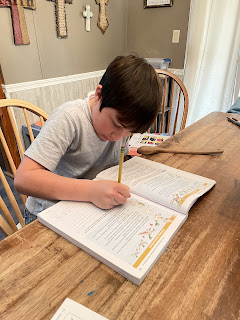
The boys are also both using A Reason for Handwriting, levels T and F. They don't like cursive, but it's an important skill for them to learn and have so I continue to make them do it. It takes around 5 minutes a day - not that big of a sacrifice for them!
They also have independent reading that goes along with Drawn into the Heart of Reading, but we don't use all of the worksheets in the book. We pick and choose, skipping some and completing some. The worksheets were making the boys hate reading time, so I decided it wasn't worth it!
We also just started Titus with A Reason for Spelling because he needed some extra practice. We're only on our third week, so I can't really speak much about it other than we really like the gentle approach!
They also have plenty of real-life experiences every day doing farm chores like feeding and taking care of animals and collecting eggs. Titus just started Tae-Kwon-Do and is enjoying it so far! Silas plans to play junior high football this year at our local school (he is allowed to play as a homeschooler). I'm glad they are pursuing their own interests. Sometimes it seems like they're the same person as far as hobbies and interests, and although I want them to be best frineds (and they are), I also want them to be their individual self. It's going to be good for them to have separate activities.
I'm really thankful that they have plenty of time to be outdoors. We're done with school by lunchtime, so they have the rest of the day to go outside for chores and free time.
When did your kids start pursuing separate interests, or have they always?
Tuesday, February 2, 2021
Middle School Monday - Week in Review
Tuesday, January 26, 2021
Middle School Monday - Gordon Korman books
Anyway, I thought I would share some of Mercie's recent free reading materials. She is in the 7th grade and will be 13 years old on the 6th of February! She loves to read and has been introduced to a new author that we both love to read - Gordon Korman. I'm sure many of you have heard of him or read his books, but we had only read one of his books - Swindle - before. I ordered Mercie a set of six books by him because when I read the descriptions of the books, they sounded like something she would enjoy! I'm going to link to each of the books and give a short summary. I've read them all and she has read most of them, and they are all really great books - boys and girls alike would enjoy them, although the main characters are always boys.
The Unteachables are a notorious class of misfits, delinquents, and academic train wrecks. Like Aldo, with anger management issues; Parker, who can’t read; Kiana, who doesn’t even belong in the class—or any class; and Elaine (rhymes with pain). The Unteachables have been removed from the student body and isolated in room 117.
Their teacher is Mr. Zachary Kermit, the most burned-out teacher in all of Greenwich. He was once a rising star, but his career was shattered by a cheating scandal that still haunts him. After years of phoning it in, he is finally one year away from early retirement. But the superintendent has his own plans to torpedo that idea—and it involves assigning Mr. Kermit to the Unteachables.
The Unteachables never thought they’d find a teacher who had a worse attitude than they did. And Mr. Kermit never thought he would actually care about teaching again. Over the course of a school year, though, room 117 will experience mayhem, destruction—and maybe even a shot at redemption.
Chase doesn't remember falling off the roof. He doesn't remember hitting his head. He doesn't, in fact, remember anything. He wakes up in a hospital room and suddenly has to learn his whole life all over again . . . starting with his own name.
He knows he's Chase. But who is Chase? When he gets back to school, he sees that different kids have very different reactions to his return.
Some kids treat him like a hero. Some kids are clearly afraid of him.
One girl in particular is so angry with him that she pours her frozen yogurt on his head the first chance she gets.
Pretty soon, it's not only a question of who Chase is--it's a question of who he was . . . and who he's going to be.
When Donovan Curtis pulls a major prank at his middle school, he thinks he’s finally gone too far. But thanks to a mix-up by one of the administrators, instead of getting in trouble, Donovan is sent to the Academy of Scholastic Distinction, a special program for gifted and talented students.
Although it wasn’t exactly what Donovan had intended, the ASD couldn’t be a more perfectly unexpected hideout for someone like him. But as the students and teachers of ASD grow to realize that Donovan may not be good at math or science (or just about anything), he shows that his gifts may be exactly what the ASD students never knew they needed.
Capricorn (Cap for short) lived every day of his life on Garland Farm growing fruits and vegetables. He was homeschooled by Rain, the only person he knew in the world. Life was simple for Cap. But when Rain falls out of a tree while picking plums and is hospital-ridden, he has to attend the local middle school and live with his new guidance counselor and her irritable daughter. While Cap knew a lot about Zen Buddhism, no amount of formal education could ready him for the trials and tribulations of public middle school.
Cap doesn't exactly fit in at Claverage Middle School (dubbed C Average by the kids). He has long, ungroomed hair, wears hemp clothes, and practices Tai Chi out on the lawn. His weirdness basically makes him the biggest nerd in school. This is great news for Zach Powers, big man on campus. He can't wait to instate the age-old tradition in C-Average School: The biggest nerd is nominated for class president -- and wins. So when Cap becomes president, he is more puzzled than ever. But as Cap begins to take on his duties, the joke starts to turn on Zach.
Will Cap turn out to be the greatest President in the history of C-Average School? Or the biggest punchline?
Cooper Vega's family moves so often that he's practically invisible at any school he attends. Now they've relocated to the town of Stratford -- where nobody even makes an effort to learn Cooper's name. To them, he's just . . . whatshisface.
Cooper's parents feel bad about moving him around so much, so they get him a fancy new phone. Almost immediately, it starts to malfunction. First there's a buzzing. Then there's a weird glare on the screen. Then that glare starts to take on the form of . . . a person?
It's not just any person trapped inside Cooper's phone. It's a boy named Roderick, who says he lived in the time of William Shakespeare -- and had a very tangled history with the famous playwright. Cooper thinks his phone has gone haywire, but there's nothing he can do to get rid of Roderick.
Then, even stranger, Roderick starts helping him. Even though his 17th-century advice isn't always the best for a 21st century middle school.
Oops.
It's time for some serious damage control -- so Cameron and his friends invent a fake school club that will make it seem like they're doing good deeds instead of slacking off. The problem? Some kids think the club is real -- and Cameron is stuck being president.
Soon Cameron is part of a mission to save a beaver named Elvis from certain extinction. Along the way, he makes some new friends -- and some powerful new enemies. The guy who never cared about anything is now at the center of everything . . . and it's going to take all his slacker skills to win this round.